 Skip-the-line available
 The story of the Lady with an Ermine, and how it reached Kraków
From the Sforza court in Milan around 1490 to a palace by St Florian's Gate: the five centuries behind Leonardo's portrait of Cecilia Gallerani.
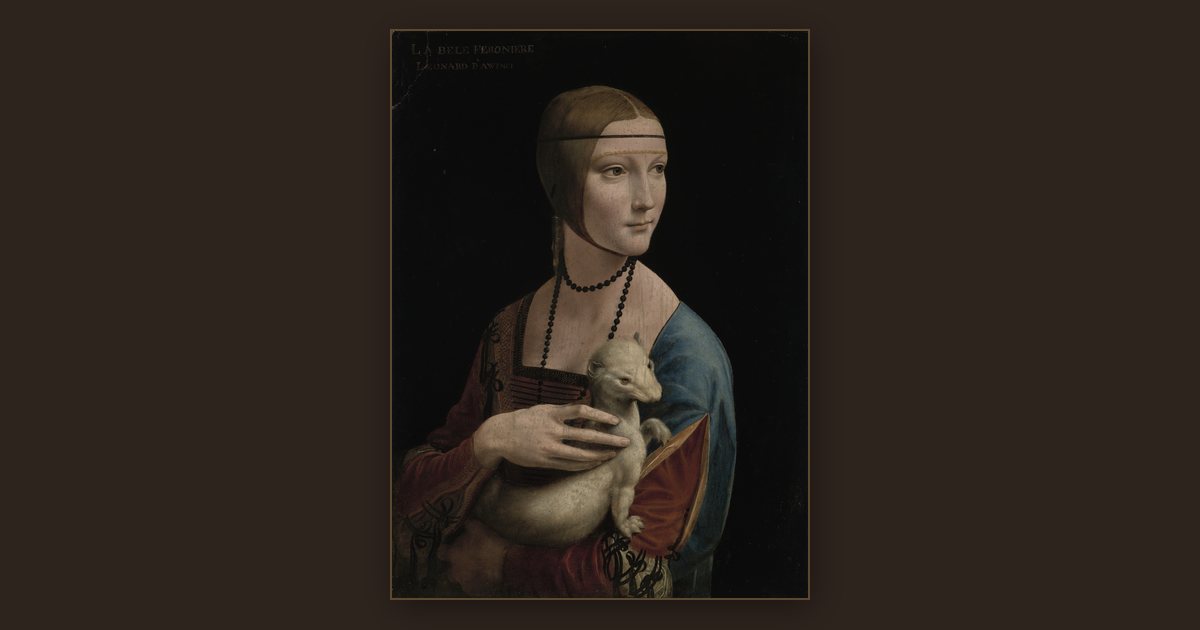
The Lady with an Ermine is Leonardo da Vinci's portrait of Cecilia Gallerani, a teenager at the Sforza court in Milan, painted in oil on a walnut panel between about 1489 and 1491. It is in Kraków because Prince Adam Jerzy Czartoryski bought it in Italy in 1798, and his family carried it through war, exile and occupation until it settled in their museum beside St Florian's Gate. Along the way the panel was hidden from the Russian army in 1830, kept in Paris at the Hôtel Lambert, brought to Kraków in 1876, seized by the Nazis in 1939 and returned to Poland in 1946. Since December 2016 it has belonged to the Polish state, and since 19 December 2019 it has hung again in the restored Czartoryski Palace. Here is the story, in order.
Who was the Lady with an Ermine, and why did Leonardo paint her?
In the late 1480s Leonardo da Vinci was court painter to Ludovico Sforza, known as Il Moro, the ruler of Milan. Between about 1489 and 1491 he painted a young woman of that court in oil on a walnut panel only 54.8 by 40.3 centimetres, small enough to carry under one arm. The sitter holds an ermine, and that animal gave the picture its name.
She is Cecilia Gallerani. Born in Siena in early 1473, she was the daughter of Fazio Gallerani, who held diplomatic posts at the Milan court, and she grew up with six brothers and an education in Latin and literature. She was about 16 when Leonardo painted her, and by then she had become the favourite and best known of Ludovico's mistresses.
The portrait caught a moment that did not last. Cecilia gave birth to Ludovico's son, Cesare, on 3 May 1491, and around the same time Ludovico married Beatrice d'Este, who insisted that Cecilia leave the Castello Sforza. In 1492 she married Ludovico Carminati de' Brambilla, later hosted a literary salon, and died in 1536. Years after the sitting she wrote to Isabella d'Este that the picture no longer looked like her, because she had been so young when it was made.
What does the ermine in the painting mean?
The animal works on several levels at once. The ancient Greek word for ermine, galê, echoes the first syllables of Gallerani, so the creature in her arms is a play on her name. It also points straight at Ludovico: in 1488 Ferdinand I of Naples made him a member of the Order of the Ermine, and he used the animal as a personal emblem.
The ermine stood for purity and moderation too, a virtue as much as a pet. It has also been linked to pregnancy, as an animal thought to protect pregnant women, and it appears often in Renaissance marriage imagery. None of these readings cancels the others, which is one reason the picture rewards a slow look.
The panel is the second of only four surviving portraits of women by Leonardo, alongside Ginevra de' Benci, La Belle Ferronnière and the Mona Lisa. Even so, scholars only widely accepted it as his work in the 20th century. A technical study in 1992 found that damage was limited to the background, which was probably bluish-grey at first and was painted over in black around the middle of the 18th century.
How did a Leonardo end up in Poland?
In 1798 Prince Adam Jerzy Czartoryski, travelling in Italy, bought the painting there. On the same Italian travels he brought back Raphael's Portrait of a Young Man, painted around 1513 to 1514, together with Roman antiquities.
In 1800 the Leonardo joined the Czartoryski family collections at Puławy. The inscription LEONARD D'AWINCI in the upper left corner dates from this time: it was probably added by a restorer soon after the panel reached Poland, so you are not looking at Leonardo's own signature when you spot it.
The Raphael is the larger of the two pictures, oil on a panel of 72 by 56 centimetres against the Leonardo's 54.8 by 40.3. From 1798 the two portraits shared the collection's fortunes, through Puławy, Paris and Kraków, until the Second World War separated them for good.
What did Princess Izabela Czartoryska build at Puławy?
The figure who turned a family's possessions into a museum was Princess Izabela Czartoryska, born Flemming. She began the collection in 1796, starting with trophies from the victory over the Turks at Vienna in 1683, under the motto The Past to the Future.
In 1801 she opened her collection of national memorabilia and art to the public at Puławy, in two pavilions. The first was the Temple of the Sibyl, opened that year, designed by Chrystian Piotr Aigner and modelled on the Temple of Vesta at Tivoli; it held Polish memorabilia including the Royal Casket. The second, the Gothic House, was finished in 1809.
By the early 19th century the family owned three masterpieces that still define the collection's story: Leonardo's Lady with an Ermine, Rembrandt's Landscape with the Good Samaritan and Raphael's Portrait of a Young Man. The Royal Casket from the Temple of the Sibyl survives too, and today sits in a display case in Kraków.
How did the painting travel from Puławy to Paris and then to Kraków?
The first crisis came with the November Uprising of 1830. As the Russian army advanced, the 84-year-old Princess Czartoryska rescued the Leonardo, hid it and sent it about 150 kilometres south to the family palace at Sieniawa.
After the uprising fell in 1831 the family's property was confiscated, and the Puławy collection was evacuated to Paris under Prince Adam Jerzy Czartoryski. In 1843 he established it at the Hôtel Lambert, which became a centre of the Polish emigration. For more than three decades the Leonardo lived in exile with the family that owned it.
In 1870 Prince Władysław Czartoryski decided to move the collections to Kraków, and they arrived in 1876. The city provided buildings next to St Florian's Gate on the old city walls, and the museum opened there in 1878.
Those buildings are still the museum: the Czartoryski Palace, the Klasztorek and the Arsenał, with the entrance at ul. Pijarska 15. When you walk in, you are entering the home the collection was given in 1876.
What happened to the Lady with an Ermine in the Second World War?
In August 1939, ahead of the German occupation, sixteen cases of the museum's most precious objects were taken to Sieniawa, and the Leonardo went with them, back to the hiding place of 1830. This time it did not work. The Nazis found and seized the hoard, and the Lady was sent to the Kaiser Friedrich Museum in Berlin. In January 1940 a final selection of the 85 most important items from the museum was sent to Dresden. The family's masterpieces, the Raphael among them, were earmarked for Hitler's planned collection at Linz.
In 1940 Hans Frank, the Nazi Governor-General of occupied Poland, saw the painting in Berlin and asked for it to be returned to Kraków, where it hung in his suite of offices at Wawel Castle. When the Germans evacuated in January 1945, the paintings left Wawel too.
At the end of the war Allied troops found the Lady with an Ermine in Frank's country home at Schliersee in Bavaria, and in 1946 it was returned to Poland.
Raphael's Portrait of a Young Man did not. It was last seen at Wawel in January 1945 and its whereabouts have been unknown ever since; after Frank's arrest on 3 May 1945 it was among the artefacts missing from storage, and its original frame is still kept in Kraków, empty. The museum lists 377 gold coins and 329 museum objects from the collection that have never been recovered.
How did the painting become state property, and when did the museum reopen?
From 1950 to 1991 the collection was cared for by the National Museum. After 1991 it was managed by the Princes Czartoryski Foundation. In the second half of the 20th century the panel travelled more widely than any other Leonardo painting, with exhibitions in Warsaw in 1952, Moscow in 1972, Washington, D.C. in 1991 to 1992 and Florence in 1999 among its stops.
The palace closed for renovation in 2010. In December 2016 the Polish State Treasury bought the collection together with the palace and handed it to the National Museum in Kraków, which means the Lady with an Ermine now belongs to the Polish state. While work continued, the painting was shown at the museum's Main Building from May 2017.
At the end of 2019 the palace rooms reopened after a thorough conservation renovation, and on 19 December 2019 the Lady with an Ermine returned to the reopened museum. The Arsenał followed after its own renovation in 2021, and the Klasztorek opened in 2023.
Where can you see the Lady with an Ermine today?
The painting hangs in the Czartoryski Palace at ul. Pijarska 15, beside St Florian's Gate. The route runs through 21 rooms on two floors; on the second floor you pass the Antique Salon and the Renaissance room before reaching the room given to art of Rembrandt's time and the Lady with an Ermine. Photography without flash or tripod is generally allowed, but follow any signage in the room.
Entry is by timed ticket in 10-minute slots, Tuesday to Sunday from 10:00 to 18:00, with last entry at 17:00; the museum is closed on Mondays. Only about eight places per slot are released online, so popular times go early. We book timed entry for the day and slot you choose and email you the e-ticket. It is a bearer ticket and cannot be exchanged for another date.
Two useful extras: on Tuesdays entry is free, with a limited number of timed tickets handed out at the museum desk on the day only, and pupils and students under 26 with a school or student ID can get a token-price ticket from the museum, including at the desk. We do not sell either of those.
Frequently asked
Who is the woman in the Lady with an Ermine?
She is Cecilia Gallerani, born in Siena in 1473 and about 16 when Leonardo painted her in Milan. She was the favourite mistress of Ludovico Sforza, ruler of Milan, and later married, hosted a literary salon and died in 1536.
When was the Lady with an Ermine painted?
Leonardo painted it between about 1489 and 1491, while he was court painter to Ludovico Sforza in Milan. It is oil on a walnut panel measuring 54.8 by 40.3 centimetres.
How did the Lady with an Ermine end up in Kraków?
Prince Adam Jerzy Czartoryski bought it in Italy in 1798 and brought it to Puławy in 1800. The family collection went into exile in Paris after 1831, arrived in Kraków in 1876, and the museum by St Florian's Gate opened in 1878.
Why is she holding an ermine?
The ermine carries several meanings at once. Its Greek name, galê, puns on Gallerani; it was Ludovico Sforza's emblem after he joined the Order of the Ermine in 1488; and it symbolised purity and moderation.
Was the Lady with an Ermine stolen in the Second World War?
Yes. The Nazis seized it in 1939 and sent it to Berlin, then Hans Frank hung it in his offices at Wawel Castle. Allied troops found it at his home in Schliersee, Bavaria, and it returned to Poland in 1946.
Who owns the Lady with an Ermine now?
The Polish state owns it. In December 2016 the State Treasury bought the Czartoryski collection and palace and handed them to the National Museum in Kraków, and the painting has hung in the reopened palace since 19 December 2019.
Is Raphael's Portrait of a Young Man still missing?
Yes. Raphael's portrait was last seen at Wawel Castle in January 1945 and has never been found. It is one of 329 museum objects, alongside 377 gold coins, that the collection has never recovered.