 Skip-the-line available
 Where to see Leonardo's Lady with an Ermine in Kraków
The museum, the room, the 10-minute entry slots and what to look for once you are standing in front of Leonardo's portrait.
Leonardo da Vinci's Lady with an Ermine hangs in the Czartoryski Museum at ul. Pijarska 15 in Kraków, part of the National Museum in Kraków, in the palace beside St Florian's Gate. To see it you need a ticket for a specific date and 10-minute entry slot, and the painting waits on the 2nd floor, in the room after the Antique Salon and the Renaissance room. The museum opens Tuesday to Sunday from 10:00 to 18:00, with last entry at 17:00, and it is closed on Mondays. Only about eight online places are released per slot, so dates close to today often show nothing left. This guide covers the building, the route, the timed-entry system, how Mondays and Tuesdays differ, what to look for in the portrait and how booking through us works.
Which museum in Kraków has Lady with an Ermine?
The painting belongs to the Czartoryski Museum, known in Polish as Muzeum Książąt Czartoryskich, which is run as a branch of the National Museum in Kraków (Muzeum Narodowe w Krakowie, usually shortened to MNK). The entrance address is ul. Pijarska 15, 31-015 Kraków. You may see ul. św. Jana given elsewhere for the palace, but Pijarska 15 is the address the museum itself uses for visitors.
The museum is a small complex of three buildings: the Czartoryski Palace, the Klasztorek and the Arsenał. They stand next to St Florian's Gate on the old city walls, at the northern edge of the Old Town. The city of Kraków gave the family these buildings when the collection came back to Polish soil in 1876, and the museum opened here in 1878. The Arsenał reopened after renovation in 2021 and the Klasztorek opened in 2023.
By public transport, the nearest stop is Stary Kleparz, served by trams 4, 14, 18, 20 and 52 and by buses 124, 152 and 424. From the stop it is a short walk south towards St Florian's Gate. If you are already in the Old Town, simply walk north to the gate and look for Pijarska, the street that runs along the inside of the walls.
Where in the building is the painting?
The visit follows a set route through 21 exhibition rooms on two floors of the renovated palace. It begins at the Podest, the landing where two monumental genre canvases by Jean-Pierre Norblin hang, and continues through rooms on the Czartoryski family and rooms on Polish history. A display case along the way holds the Royal Casket, which Princess Izabela Czartoryska showed at Puławy in the Temple of the Sibyl from 1801.
Lady with an Ermine is on the 2nd floor. That floor opens with the Antique Salon, continues into the Renaissance room and then leads into the room with Leonardo's portrait. In the museum's own virtual walk this space is called the room of Art of Rembrandt's time and the Lady with an Ermine, so you will find Dutch painting close by. If you are tempted to hurry upstairs, the rooms before it are worth a slower look, because they explain how the family's collection came together.
Every level is adapted for visitors with reduced mobility: there are lifts, wide corridors and accessible toilets on the ground floor. The museum also offers audio description, a guide for Deaf visitors, a sensory path and a quiet zone, which helps if you are visiting with someone who finds busy rooms tiring.
How does timed 10-minute entry work?
Every ticket is for a specific day and a specific time, whether it is bought online or at the museum desk. Entry slots run on 10-minute marks, but not every mark is released for online sale. For October 2026 the online calendar showed 22 slots a day, starting at 10:10 and ending at 17:00, with groups such as 11:10, 11:20 and 11:30, then 12:20 to 12:40, and a long run from 15:50 to 17:00.
Capacity per slot is small. The most free online places we saw for any single slot was eight; on 23 October 2026, for example, slots showed 4, 6, 8, 8, 6, 8, 7 and 2 places. Across 22 online slots, that is at most around 176 online places a day, and usually fewer. When we checked on 8 October 2026, every online slot for that same day showed zero places left.
The museum keeps an additional pool of tickets at its own desk, so online availability can run out while the desk still has some. That pool is not something you can reserve in advance, though, and it is not a plan to rely on if Kraków is a short stop on a longer trip. If you have a fixed day in mind, booking a timed slot ahead is the dependable route.
Your slot is your entry time, not a time limit for the visit. Once inside you can stay until closing at 18:00, but leave enough time to collect anything from the cloakroom before the doors close.
Why do Mondays and Tuesdays work differently?
Mondays are simple: the museum is closed every Monday, so there are no slots at all. Plan Kraków days with that in mind, because it is easy to arrive on a Sunday evening and assume Monday will work.
Tuesdays are different in a more interesting way. Every Tuesday, entry to the permanent exhibitions is free. Tickets still carry a date and an entry time, numbers are limited, and they are handed out only at the Czartoryski Museum ticket desk on the day of the visit itself. You cannot book them in advance, and we do not sell Tuesdays. If you are flexible and happy to queue at the desk early, it is a good option; if you need certainty, choose another day.
A few dates in 2026 also break the normal pattern. The museum is closed on 1 November and on 24 and 25 December. On 11 November and 26 December it opens from 10:00 to 16:00, and on 31 December the Czartoryski Museum opens from 10:00 to 14:00. Slots on those short days end earlier than usual.
How can you choose a quieter slot?
The museum does not publish visitor numbers by hour, so treat what follows as suggestion rather than data. Because every slot is capped, the room never fills the way an open-entry gallery can. Even so, the rooms ahead of you on the route are shared with everyone who entered in the slots just before yours.
The first slot of the day, 10:10, is a sensible choice if you want to reach the 2nd floor before the building has filled up behind you. The last slots, from 16:30 to 17:00, can also suit people who prefer a slower pace, though you have at most an hour before closing at 18:00, so you may need to move through the earlier rooms quickly.
As a general pattern in city museums, weekdays tend to be calmer than weekends. If your dates allow, a Wednesday or Thursday morning is a reasonable bet. Whatever you choose, once you are in the room there is no fixed time in front of the painting, so you can step back, let others move forward and return to it.
What should you look for in the painting?
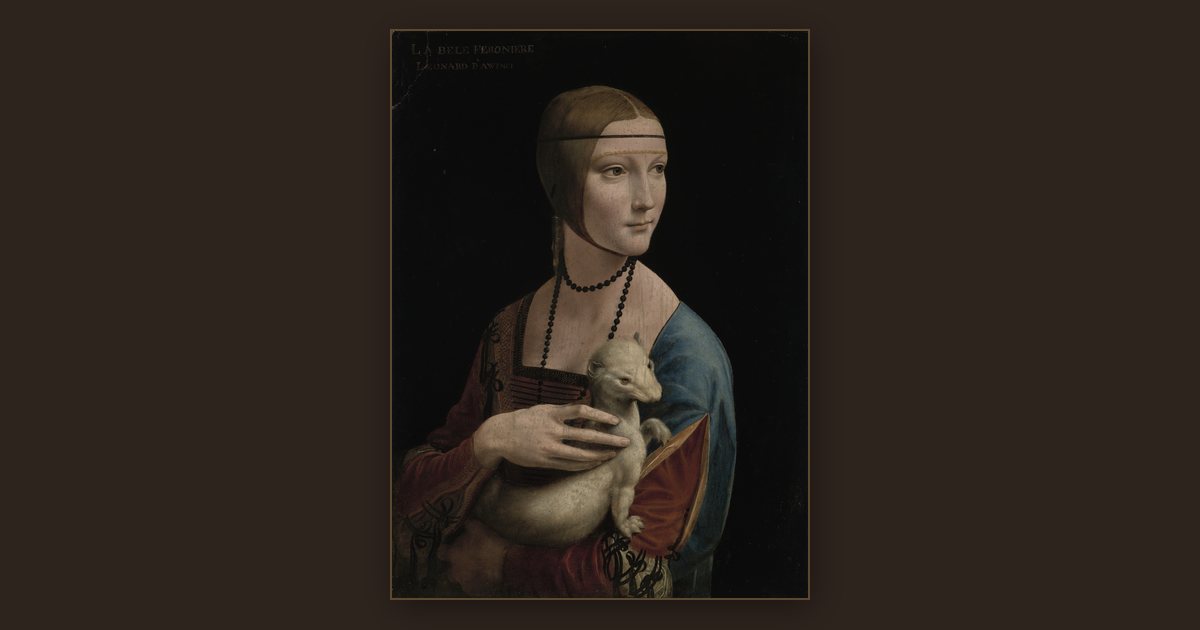
Leonardo painted Lady with an Ermine between 1489 and 1491, in oil on a walnut panel. It is smaller than many people expect: 54.8 × 40.3 cm, roughly the size of a large book opened flat. It is one of only four surviving portraits of women by Leonardo; the others are Ginevra de' Benci, La Belle Ferronnière and the Mona Lisa.
The sitter is Cecilia Gallerani, about 16 years old when she was painted, and the mistress of Ludovico Sforza, Duke of Milan, known as Il Moro. Leonardo was court painter to the Sforza at the time. Notice the pose: her body turns to her right at a three-quarter angle while her face turns to her left, as if someone outside the frame has just spoken to her.
Then look at the ermine. The animal stood for purity and moderation, and the Greek word for ermine, galê, may be a pun on the name Gallerani. Ludovico used the ermine as a personal emblem after he was made a member of the Order of the Ermine in 1488. Look closely at Cecilia's hand resting on the animal: Leonardo painted the shape of each fingernail, the lines around the knuckles and the tendon of the bent finger.
Two details were not Leonardo's. The inscription LEONARD D'AWINCI in the upper left was probably added by a restorer soon after the painting reached Poland. The black background was likely bluish-grey originally and was overpainted later. Prince Adam Jerzy Czartoryski bought the panel in Italy in 1798 and brought it to the family collection at Puławy in 1800. Seized in 1939, it hung in Hans Frank's offices at Wawel, was recovered in 1945 in Bavaria and returned to Poland in 1946.
Can you take photos, and what should you bring?
Amateur photography and filming for private use are allowed in the museum, without extra lighting, without flash and without a tripod. The exception is any object that carries its own photo ban, so check the signage in the Leonardo room before you raise your phone, and follow what the room staff ask on the day.
Bags, backpacks, suitcases and handbags larger than 40 × 20 × 25 cm, umbrellas and coats must go into the cloakroom or the lockers, which are free. Arriving a little before your slot gives you time to drop them off. A small bag that fits within those measurements can stay with you.
If you would like commentary, an audio guide can be rented at the museum, with tracks in Polish, English, French, German, Italian, Ukrainian, Russian and Spanish, plus sign language, audio description and a family route. The museum's mobile app is also available for Android and iOS. The building has a café, a shop, Wi-Fi and baby-changing facilities.
How does booking through us work?
We are an independent concierge, not the museum. You choose a date from Wednesday to Sunday and an entry slot, we book that timed entry on your behalf, and we email you the e-ticket. On the day you show it at the entrance with your slot time. The standard, reduced and family tickets we book also admit you, within three months of the date on the ticket, to the permanent exhibitions at other National Museum in Kraków branches, including Bishop Erazm Ciołek Palace, Jan Matejko House and the Stanisław Wyspiański Museum.
A family ticket covers up to four people, including at least one child under 16. Children under 7 enter free. The reduced ticket is one ticket type with specific conditions: visitors over 65, retirees and pensioners, and visitors with a disability together with one carer, if they are citizens of an EU, EEA or Swiss state; pupils, students and doctoral students who are EU, EEA or Swiss citizens and aged 26 or over; teachers at schools in Poland or in EU or EEA states; and holders of an ISIC or Euro<26 card. You must show the entitling document together with an ID at the entrance, or the reduced ticket is not honoured.
If you are a pupil or a student under 26 with a school or student ID, the museum offers you a token-price ticket, including at its desk. We do not sell that ticket, and we would rather you used it.
Two rules matter once you have your e-ticket. It is a bearer ticket: if the details are shared, the museum admits whoever presents it first, so do not post it or forward it. And it cannot be exchanged for another date, so check your Kraków itinerary, especially against Mondays and the 2026 closure days, before you confirm.
Frequently asked
Where is Lady with an Ermine displayed?
It hangs in the Czartoryski Museum, ul. Pijarska 15, Kraków, a branch of the National Museum in Kraków. The room is on the 2nd floor, after the Antique Salon and the Renaissance room.
Do I need to book a time slot to see it?
Yes. Every ticket is for a specific date and 10-minute entry slot. Only about eight online places are released per slot, so near dates often sell out. The museum desk keeps a separate pool you cannot reserve.
Is the museum open on Mondays?
No. The Czartoryski Museum is closed every Monday. From Tuesday to Sunday it opens from 10:00 to 18:00, and the last visitors are admitted at 17:00.
Can I visit on a Tuesday?
Yes, and entry to the permanent exhibitions is free on Tuesdays. The timed tickets are limited and handed out only at the museum desk on the day, so they cannot be booked ahead. We do not sell Tuesday entry.
Can I photograph Lady with an Ermine?
Private, non-flash photography is generally allowed, without a tripod or extra lighting. Objects with their own photo ban are the exception, so check the signage in the room and follow staff instructions.
Can I change the date on my ticket?
No. Tickets cannot be exchanged for another date or another ticket. They are bearer tickets, so the museum admits whoever presents the ticket first. Keep your e-ticket private and confirm your dates before booking.
How big is the painting?
It measures 54.8 × 40.3 cm and is painted in oil on a walnut panel. Leonardo made it between 1489 and 1491, and it is smaller than many visitors expect.