 Skip-the-line available
 What to see in the Czartoryski Museum besides the Lady with an Ermine
Norblin's canvases, Princess Izabela's rooms, the Royal Casket, a rare Rembrandt landscape and the missing Raphael, room by room.
Apart from the Lady with an Ermine, the Czartoryski Museum takes you through 21 rooms on two floors of the renovated palace in Kraków. You will see Jean-Pierre Norblin's two monumental genre canvases at the Podest, rooms on the Czartoryski family and Princess Izabela, Polish history with the Royal Casket display case, medieval art, the Antique Salon, a Renaissance room and Rembrandt's Landscape with the Good Samaritan of 1638, one of only six oil landscapes he painted. You also meet the absence of Raphael's Portrait of a Young Man, missing since 1945. This guide walks the route in order, explains what each stop means, and lists the nine other National Museum displays your standard, reduced or family ticket opens for three months afterwards.
How is the route through the 21 rooms laid out?
The permanent exhibition runs through 21 rooms on two floors of the renovated Czartoryski Palace at ul. Pijarska 15, beside St Florian's Gate on the old city walls. The museum sets out the order itself: the walk begins at the Podest with two monumental genre canvases by Jean-Pierre Norblin, continues through rooms devoted to the Czartoryski family and rooms on Polish history, and on the second floor opens with the Antique Salon, then the Renaissance room, then the room with the Lady with an Ermine.
That order matters. Leonardo comes near the end, so the earlier rooms tell you how one princely family built a collection able to hold him. The museum's online virtual walk names three spaces you can preview: the Czartoryski rooms, a room titled "Art of Rembrandt's time and the Lady with an Ermine", and a room of medieval art. Next door, in the Arsenał, sits the ancient-art gallery called Sources.
The frame for your visit: Tuesday to Sunday 10:00 to 18:00, closed Mondays, last entry 17:00. Entry is by timed ticket in 10-minute slots, with about eight online places per slot and an additional pool at the museum desk. Every level has lifts and wide corridors, with accessible toilets on the ground floor, so the whole route works step-free.
Why does the visit start with Norblin's canvases at the Podest?
Jean-Pierre Norblin (1745 to 1830) was a French painter who met Prince Adam Kazimierz Czartoryski around 1772 or 1774 and travelled with him for two years. From 1774 he worked for the family as court artist and tutor to the children, living in Poland until 1796 and working as painter and decorator at the Puławy and Powązki estates.
His manner joined the Rococo tradition of fêtes galantes and country festivities with a running panorama of daily life and current political events, and he painted a gallery of portraits drawn from every social class. That makes his two monumental genre canvases at the Podest a fitting opening: you meet the Czartoryski world first through the eyes of the family's own house artist.
Norblin also ties the start of the route to one of its high points. He bought Rembrandt's Landscape with the Good Samaritan at a Paris auction for Princess Izabela Czartoryska's Gothic House at Puławy, so the painter who greets you at the Podest helped stock the collection you are about to walk through. His pupils in Poland included Aleksander Orłowski, Michał Płoński and Jan Rustem.
Who was Princess Izabela, and what do the Czartoryski rooms tell you?
In 1801, at Puławy, Princess Izabela Czartoryska, née Flemming, opened her collection of national memorabilia and art to the public. She showed it in two pavilions: the Temple of the Sibyl, opened in 1801, designed by Chrystian Piotr Aigner and modelled on the Temple of Vesta at Tivoli, and the Gothic House, finished in 1809.
From the early 19th century the family owned three masterpieces: Leonardo's Lady with an Ermine, Rembrandt's Landscape with the Good Samaritan and Raphael's Portrait of a Young Man. The Czartoryski collection also includes Alexander Roslin's 1774 portrait of Izabela herself. The museum's motto is "The Past to the Future".
The family rooms then follow the collection's travels. After the November Uprising failed in 1831, the Puławy holdings were evacuated to Paris under Prince Adam Jerzy Czartoryski, who set them up at the Hôtel Lambert in 1843, a centre of the Polish emigration. In 1876 they returned to Polish soil in Kraków, where the city provided buildings next to St Florian's Gate, and the museum opened in 1878.
What is the Royal Casket, and what do the Polish history rooms show?
The rooms on Polish history come in the first part of the route, before you reach the second floor. The museum's own virtual walk shows national mementoes placed in a display case with the Royal Casket, and that case is the one to find, because it carries the founding idea of the whole museum.
The Royal Casket was a memorial Izabela Czartoryska created in 1800: a large wooden casket holding 73 precious relics that had once belonged to Polish royalty, inscribed "Polish mementos assembled in 1800 by Izabela Czartoryska". It stood in the Temple of the Sibyl at Puławy, the first of her two pavilions, and later travelled to Kraków with the rest of the collection.
Its war story is a sober one. In 1939 it was taken with the collection to Sieniawa and hidden in a repository; Wehrmacht soldiers who entered Sieniawa on 14 September 1939 robbed the casket and shared its contents among themselves, and Wikipedia records no recovery. The museum counts 377 gold coins and 329 museum objects from the collection as never recovered to this day. Read the case labels closely to see what is displayed now.
Where do medieval art, the Antique Salon and the ancient gallery fit in?
Medieval art has a room of its own, and it is one of the three spaces in the museum's virtual walk, which you can preview at home with Polish or English narration and in sign-language, audio-description and simplified-language versions. A few minutes with it before you travel makes the room easier to read on the day.
On the second floor the route opens with the Antique Salon. The taste it reflects goes back to the family's early buying in Italy, where Prince Adam Jerzy Czartoryski acquired Roman antiquities along with Raphael's portrait and the Lady with an Ermine.
For antiquity at full scale, the branch also presents "Sources. Gallery of Ancient Art" in the Arsenał, a preserved and renovated fragment of the city walls that reopened in 2021. It covers Egypt, Greece, Italy and Asia Minor, plus Polish prehistory and Greek coins, drawing on the collection of Władysław Czartoryski (1828 to 1894) and the Potocki family of Krzeszowice. Look for the cartonnage with the mummy of Asetemachbit, dated to Egypt's 22nd to 23rd dynasties, the 9th century BC. Ask at the desk which Arsenał displays your ticket covers on the day.
What leads up to Leonardo: the Renaissance room and Rembrandt's landscape?
The Renaissance room sits between the Antique Salon and the Lady with an Ermine. The Czartoryski collection's Italian holdings include Garofalo's Adoration of the Magi (1510 to 1513), Francesco Montemezzano's Woman in a Niche (Pomona) from the 16th century, and an early 16th-century tondo of the Adoration of the Child with the Young St John the Baptist by an unknown Italian painter. The museum does not publish which works hang in which room, so treat these as the collection's range rather than a checklist.
Rembrandt's Landscape with the Good Samaritan is the second of the three masterpieces the family owned from the early 19th century. Painted in 1638 in oil on an oak panel measuring 46.2 by 65.5 cm, it is one of only six oil landscapes Rembrandt painted.
The subject is the parable of the Good Samaritan from the Gospel of Luke, but Rembrandt folds the story into the landscape rather than painting it as an isolated scene. The panel is small, so give it time and look for the figures of the parable within the scenery.
Its history mirrors the Lady's. Norblin bought it at auction in Paris for Izabela's Gothic House at Puławy; it moved with the collection to Kraków, was among the paintings looted by the Germans in 1939, and came back after the war thanks to research by the art historian Karol Estreicher. The museum's virtual walk names a room "Art of Rembrandt's time and the Lady with an Ermine".
What should you know about the Lady with an Ermine room and the missing Raphael?
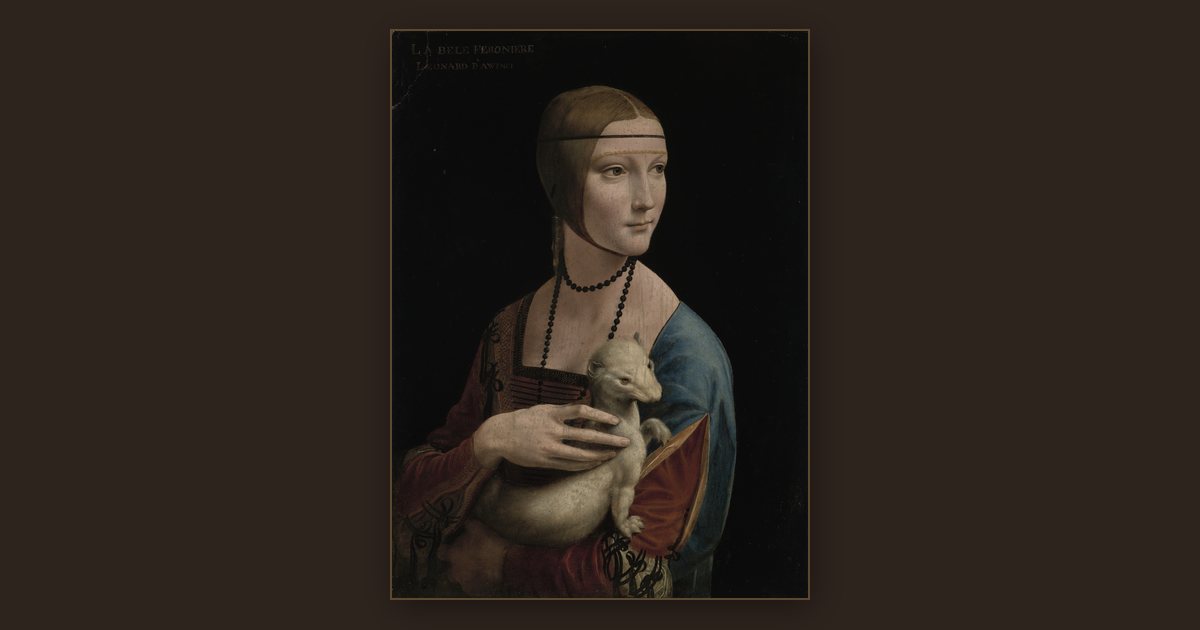
The Lady with an Ermine closes the second-floor sequence. Leonardo painted it in 1489 to 1491 in oil on a walnut panel of 54.8 by 40.3 cm. The sitter is Cecilia Gallerani, about 16 at the time, and it is one of only four surviving portraits of women by Leonardo. It returned to the reopened palace on 19 December 2019.
The third masterpiece is the one you cannot see. Raphael's Portrait of a Young Man, painted in oil on panel in 1513 to 1514, was acquired in Italy by Prince Adam Jerzy Czartoryski, who bought the Lady with an Ermine there in 1798. In 1939 it was hidden at Sieniawa and found by the Gestapo; Hans Frank, governor of the German-occupied General Government, displayed it in his Kraków residence, and it was last documented at Wawel Castle in January 1945.
Many historians call it the most important painting missing since the Second World War. Wikipedia notes that its original empty frame hangs in the National Museum in Kraków. Knowing this story turns the Lady from a single famous picture into the survivor of a trio.
Amateur photography for private use is allowed without flash, tripod or extra lighting, unless an object carries its own photo ban, so follow the signage in each room. Bags larger than 40 by 20 by 25 cm, umbrellas and coats go to the free cloakroom or lockers first.
Which other National Museum branches does your ticket open for three months?
The standard, reduced and family tickets also admit you, within three months of the date printed on the ticket, to the permanent exhibitions at Bishop Erazm Ciołek Palace, Jan Matejko House, Józef Mehoffer House, the Emeryk Hutten-Czapski Museum, the Józef Czapski Pavilion, Szołayski House, the Stanisław Wyspiański Museum, the Karol Szymanowski Museum in Zakopane, and the "Arms and Colour" exhibition at the Arsenał. The pupil, student and under-7 tickets cover the Czartoryski Museum only.
The family ticket covers up to 4 people including at least one child under 16, and children under 7 go free. The reduced ticket is one combined line: visitors over 65, retirees and pensioners, and people with a disability with one carer, all as citizens of an EU, EEA or Swiss state; teachers at Polish or EU and EEA schools; and holders of an ISIC or Euro<26 card. You must show the entitling document with an ID on the day, or the reduced ticket is not honoured.
Every Tuesday entry is free, with limited timed tickets handed out at the museum desk on the day, and pupils and students under 26 with a school or student ID can get a token-price ticket from the museum, including at the desk. We do not sell either. For the other days, we book your timed entry on your behalf and email the e-ticket. Tickets are bearer tickets, so the first person to present one is admitted, and they cannot be exchanged for another date.
Frequently asked
What else is in the Czartoryski Museum besides the Lady with an Ermine?
Twenty-one rooms on two floors: Norblin's two monumental genre canvases at the Podest, rooms on the Czartoryski family and Princess Izabela, Polish history with the Royal Casket display case, medieval art, the Antique Salon, a Renaissance room and Rembrandt's 1638 Landscape with the Good Samaritan.
Can I see Raphael's Portrait of a Young Man?
No. Raphael's portrait has been missing since 1945, when it was last documented at Wawel Castle in Kraków. Many historians regard it as the most important painting lost in the Second World War.
Why is Rembrandt's Landscape with the Good Samaritan special?
It is one of only six oil landscapes Rembrandt painted. The 1638 oak panel, 46.2 by 65.5 cm, was bought at a Paris auction by Jean-Pierre Norblin for Princess Izabela's Gothic House at Puławy, looted in 1939 and recovered after the war.
Does my ticket include other museums?
Yes, with a standard, reduced or family ticket. Within three months of the date on it, you can enter the permanent exhibitions at eight other National Museum sites, including Jan Matejko House and the Szymanowski Museum in Zakopane, plus the Arms and Colour exhibition at the Arsenał.
Can I take photos inside?
Yes, for private use, without flash, tripod or extra lighting. Some objects carry their own photo ban, so check the signage in each room before raising your phone.
Is there an audio guide?
Yes, audio guides are rented on site, with tracks in Polish, English, French, German, Italian, Ukrainian, Russian and Spanish, plus sign language, audio description and a family route. They are free for blind visitors, and the museum also has an app for Android and iOS.